Physical Address
304 North Cardinal St.
Dorchester Center, MA 02124
Physical Address
304 North Cardinal St.
Dorchester Center, MA 02124

Gas fees in crypto are one of the most misunderstood concepts in the diverse crypto economy. If you are an active crypto trader, it is important that you understand the whole concept of gas fees and the related aspects. Whether you’re sending crypto assets, swapping them, or interacting with the decentralized applications (dApps), this fee plays a significant role in making sure that you are able to process your transactions on the blockchain.
In this guide, I am going to tell you about how it works and how you can save money by making smarter decisions during crypto transactions.
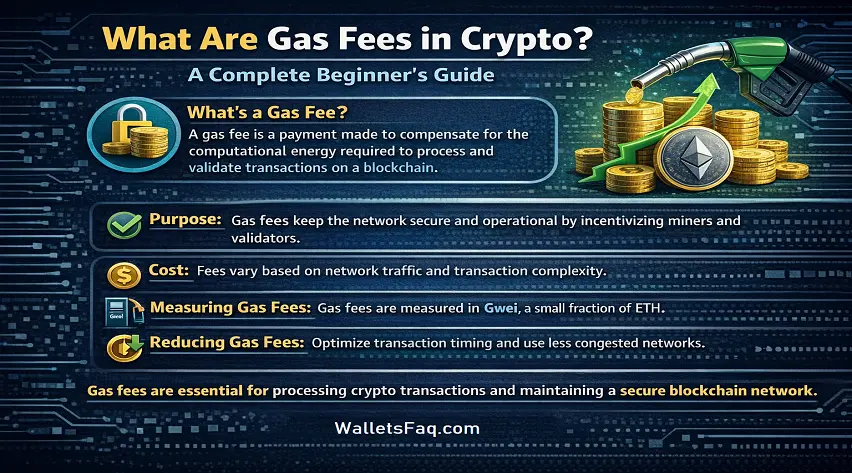
These are the transaction costs that a user has to pay in order to compensate the validators or the miners for processing your transaction and securing the transaction on a blockchain network. These fees are usually linked to networks such as Ethereum because every action requires computational effort.
To understand its working, you can consider it to be a fuel for the blockchain. Just like a vehicle needs fuel to run, similarly, gas fees fuel blockchain networks to function properly. As soon as you initiate a transaction, your request is lined up in a queue. Based on the gas fees you have paid for a particular transaction, validators will decide and prioritize the transaction. The higher the gas fee, the quicker the transaction process.
Since gas fees are not fixed, they may fluctuate depending on different acting factors, including the following:
When it comes to calculating gas fees, there are two main components that actively take part in this scenario. The first one is the amount of computational work involved in it, and the second one is the price a user is willing to pay for each unit of work. This is what the formula looks like:
Total gas fee = Gas limit × Gas price
If you want your transaction to be prioritized, you can increase the gas price.
Higher gas fees usually eat up your profits, especially if you are trading on a frequent basis. However, by taking into account some practical solutions, you can reduce the gas cost significantly:
Blockchains do not perform equally when we talk about the transaction costs. Some networks are specifically designed in such a way that they offer lower gas fees while ensuring faster processing time. Below, you can find details on the networks that comparatively have the lowest gas fees:
Gas fees are an essential part of the crypto dynamics that enable secure and efficient crypto transactions. At times, these transactions can be expensive; however, understanding how they work and how to optimize them can really make a difference. As we know, that the blockchain technology is evolving manifolds, new solutions are continuously emerging in order to reduce costs and enhance scalability. By choosing the right strategies, you can make the most of your crypto without paying a higher gas fee.
Disclaimer: This content has been published with the aim of providing information to visitors. Do not consider this to be any kind of financial advice. Since cryptocurrency is highly volatile, we recommend that you “Do Your Own Research” before investing.