Physical Address
304 North Cardinal St.
Dorchester Center, MA 02124
Physical Address
304 North Cardinal St.
Dorchester Center, MA 02124

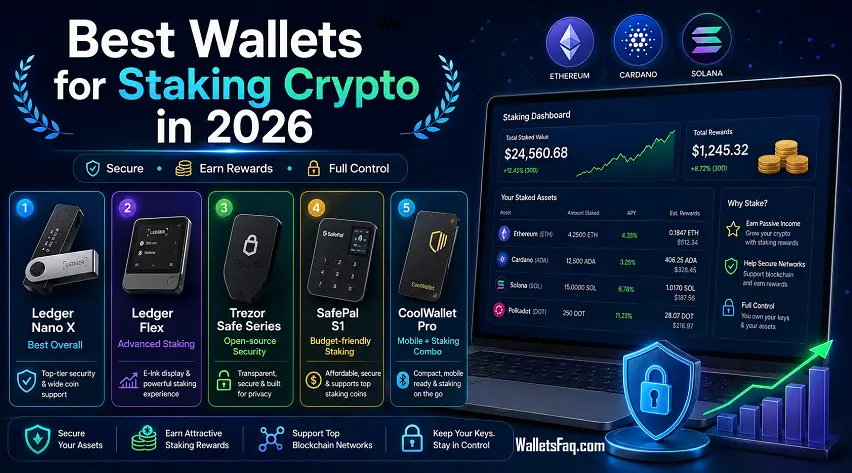
Do not let your crypto sit idly in your wallet; make it work and earn rewards. Yes, you read that right. Crypto trading is not only about sending, receiving, or storing digital assets. It is also about taking up necessary strategies so that you can increase your rewards while they are lying in your wallet. One such strategy that can help you boost your rewards is “Staking.”
Over time, it has become one of the most sought-after ways that could help you generate passive income in 2026. If you don’t know what staking is and which are the best wallets for staking crypto in 2026, then you can find that out in the sections to follow.
When we talk about crypto staking, it simply hints towards the process of taking part in the “Proof-of-Stake” blockchain by locking in or delegating your tokens to a validator. When you delegate your tokens to these validators, they can easily process transactions and maintain network security. Since your will be helping them maintain network security, in return, you are subject to earning rewards. To understand its working, take a look at the following chain:
You hold a PoS crypto > You stake it via a wallet/validator > Your funds are being used to validate the transactions > You earn rewards.
Since ETH is one of the largest PoS ecosystem, it has a mature staking infrastructure, and to date, over 30M ETH have been saved.
Since Solana has a high staking participation, i.e., 65% of its supply and charges low fees while carrying out fast transaction, you can count it to be a good staking option.
The reason why individuals love staking ADA or Cardano is that it does not have a minimum lock-in period, and there is no minimum staking requirement as well. Here are some of the options you may prefer:
The reason why you should stake your DOT crypto is that it offers a high APY (10–14%) but longer unbonding (approx. 28 days).
It is important to note that wallets do not set any rewards directly, but it is the network that does. Some of the ecosystems or networks that offer higher yields are as follows:
| Crypto | Typical APY | Wallet Examples |
| Cosmos (ATOM) | 14-20% | Keplr |
| Polkadot (DOT) | 10-14% | Fearless and Polkawallet |
| Solana (SOL) | 6-8% | Phantom and Solflare |
| Ethereum (ETH) | 3-4% | MetaMask and Ledger |
| Cardano (ADA) | 3-5% | Yoroi and Daedalus |
Read – Best Bitcoin ETFs List in 2026 for Beginners
Staking crypto in 2026 is no longer hype; it has now become a core passive income strategy for long-term crypto holders. If you ask an expert about the best wallet for staking crypto in 2026, then they would suggest you go with Trust Wallet, Ledger Wallet, Phantom Wallet, or MetaMask. Well, the choice for the best staking wallet depends completely on which crypto you’d like to stake. Among many available options, the safest options are Ethereum, Solana, Polkadot, and Cardano.