Physical Address
304 North Cardinal St.
Dorchester Center, MA 02124
Physical Address
304 North Cardinal St.
Dorchester Center, MA 02124

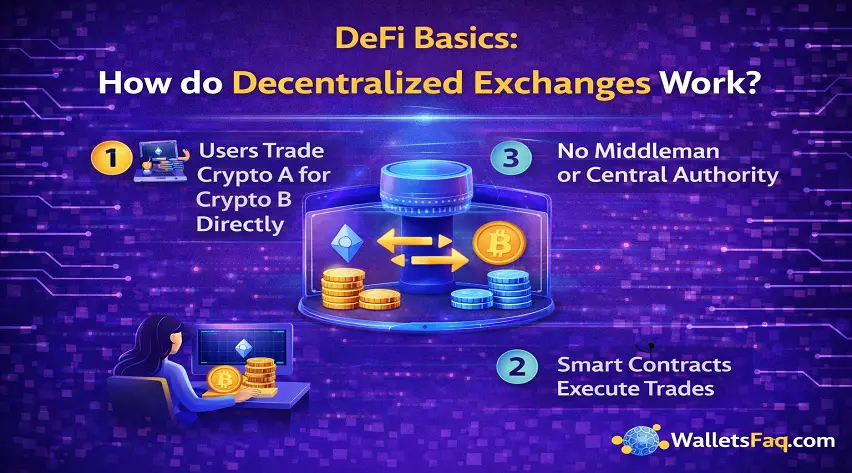
Recently got introduced to DeFi, but don’t know what it is or how it works. This article will give you deep insights into the DeFi basics, how it is connected to smart contracts, and benefits & downsides of using these exchanges.
To put it simply, we know that DeFi has transformed how individuals interact with money. This is where we also find out that DEXs (decentralized exchanges) are present at the center of this revolution. Unlike traditional financial platforms, DEXs allow users to trade cryptocurrencies directly without the involvement of any intermediaries. Speaking about a DEX, it is a blockchain-based platform that enables peer-to-peer trading of cryptocurrencies. There’s no involvement of centralized authority like a bank or broker.
It is important to note that DEXs rely on smart contracts to execute transactions automatically. This gives user’s full ownership of their funds.
To understand the working of DeFi or DEX, you should take a look at these key features:
Before anything else, please note that smart contracts are the backbone of decentralized exchanges. These are self-executing programs that run on the blockchain and automatically impose trading rules. When a user initiates a trade, the smart contract verifies the conditions and completes the transaction without human intervention. To understand the functioning of how smart contracts function in DEXs, take a look at the following points:
When compared to traditional exchanges that use order books, decentralized exchanges depend on liquidity pools. These pools are collections of funds locked in smart contracts by users known as liquidity providers. Liquidity pools work through token pairs (e.g., ETH/USDT) deposited by users, shared pools that facilitate instant trades, fee rewards distributed to liquidity providers, and constant availability of trading assets.
AMMs, or Automated Market Makers, are the algorithms meant to determine the price of assets in a liquidity pool. Instead of matching buy and sell orders, AMMs use mathematical formulas to set prices based on supply and demand. They are present to provide continuous liquidity without the involvement of order books. In addition to that, they also set or adjust the dynamic price after each trade. Moreover, the platform provides accessibility to all users, regardless of the trade size. In short, this innovation allows decentralized exchanges to function smoothly without traditional market structures.
Decentralized exchanges come with multiple advantages. But they do come with some risks as well. In this section, we shall learn about the benefits as well as risks:
Benefits:
Risks:
As blockchain technology evolves, decentralized exchanges are expected to become more user-friendly and scalable. Innovations such as layer-2 solutions and cross-chain compatibility will further improve speed and reduce transaction costs. Understanding how decentralized exchanges work is essential for anyone exploring DeFi, as they represent a major step toward a more decentralized and comprehensive financial future.
Read – Top 5 Safest Crypto Exchanges to consider in 2026
Unlike centralized exchanges, DEXs do not hold user funds or require intermediaries. Users maintain full control of their assets and trade directly from their wallets.
DEXs are generally secure because users control their funds. However, there could be risks such as smart contract bugs and phishing attacks.
Yes, but beginners may find DEX interfaces slightly complex. It’s recommended to start with small trades and learn how wallets and gas fees work.
DEXs typically charge transaction fees and network (gas) fees. The cost varies depending on the blockchain and network congestion.
Disclaimer: As blockchain technology evolves, decentralized exchanges are expected to become more user-friendly and scalable. Innovations such as layer-2 solutions and cross-chain compatibility will further improve speed and reduce transaction costs. Understanding how decentralized exchanges work is essential for anyone exploring DeFi, as they represent a major step toward a more decentralized and comprehensive financial future.